Sinnamon Cut in Bridgeport, California
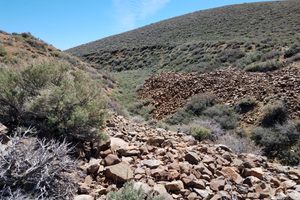
North of Mono Lake and just east of modern US 395 is an area of steep terrain containing odd pinnacles and rounded outcrops of granite. The photogenic outcrops weren't the original draw to the area, however. The local sediment is largely derived from glacial deposits originating from the Sierra Nevada and contains placer gold. Mining activity began in the late 1850s, and the camp of Monoville sprang up, centered around Rattlesnake Gulch and Bacon Gulch to its east.
For most of the year there wasn't enough water for placer operations, so a company built the Mono Ditch to bring water from the Sierra Nevada to the west, for the princely sum of $75,000. The ditch crossed Conway Summit west to east on a flume, then contoured around the slope to the east to drop into Rattlesnake Gulch and Bacon Gulch. In 1860, James Sinnamon used water from this system to conduct hydraulic mining on the east side of Bacon Gulch, at a low point into Rancheria Gulch on the east. Sinnamon recovered enough gold from this operation to buy a ranch in Bridgeport Valley, about 10 miles north. Most of the hopeful miners at Monoville were not so fortunate, and the camp was largely deserted by the late 1860s.
The trench left by Sinnamon's activity is the Sinnamon Cut. Other signs of the former placer mining operations are more subtle. A few cabins dotted around date from much later sporadic activity. What catches the geologically trained eye are cobble heaps incongruously perched above the drainages, particularly above Rattlesnake Gulch. These are spoil from the placer operations.