Azabu-Jūban Smile Monuments in Tokyo, Japan
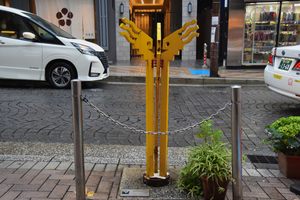
Minato City is known to be home to half of the embassies in Tokyo, particularly concentrated in the Azabu-Jūban district, arguably the most luxurious area to live in Tokyo. This is mostly due to its feudal past, when the area had a high population of daimyo lords. Following the Meiji-era abolition of samurai privileges, the daimyo mansions were converted into foreign legations.
Azabu-Jūban is also a notable shopping district, with many shops and restaurants lining the streets, some a couple centuries old. In the 1980s, it underwent a major renovation alongside the opening of a new subway line connecting the area to the rest of Tokyo. To vitalize the new Azabu-Jūban, the local committee collaborated with some of the embassies to erect a series of public sculptures, collectively referred to as "Smile Monuments."
The collection includes a number of sculptures created by Japanese and international artists. There is Smile by Pakistani artist Anjum Ayaz, which depicts a mother holding her baby. Package Deal by Australian artist Karen Genoff is a sculpted suitcase with souvenir motifs, intended to criticize the thoughtlessness of tourism. Youganu's Dream by Romanian artist Neculai Păduraru is a somewhat bizarre piece in the form of what looks like a handbag with bird heads as its strap.
Father and Son by Zimbabwean sculptor Bernard Matemera presents the titular father and son in stylized Shona style. Mother and Child by South Korean artist Lee Woon-Sik, depicts a little boy sitting on his mother's lap. Adam et Eve by French sculptor Georges Jeanclos depicts the eponymous Biblical couple in a Buddhist-inspired style.
Sun Smile by Venezuelan-American artist Jorge Blanco features a vivid yellow trio of smiling faces. The Couple by Austrian artist Josef Adam Moser is an abstract representation of what seems to be a red "M." Luck Dong by Finnish visual artist Markus Copper offers a surreal mixture of a plant seed and a bell.
The Inner and the Outer Sound by German sound installation artist Ulrich Eller takes the form of an oblong concrete block with two seashells embedded. Peace Clock by American artist Gloria Bornstein is a pop and colorful re-imagining of a Chippendale longcase clock inspired by Hiroshima's Peace Clock and the nursery rhyme "Hickory Dickory Toast." Smile on the Foot of the Ladder by Dutch sculptor Mark Brusse depicts a ladder with a frog on top of it and a pair of shoes on the lower steps.
Together, the "Smile Monuments" represent the smiles and warm hearts of people living in and visiting Azabu-Jūban, sometimes turning the heads of the passing shoppers but usually overlooked.