The Wave of Translation in Edinburgh, Scotland
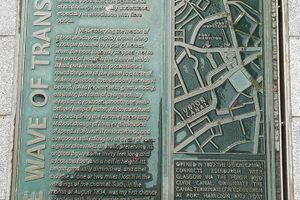
In august 1834, Scottish naval engineer and shipbuilder John Scott Russell (1808 - 1882) was riding his horse along the Union Canal, a 31 mile (51km) stretch of water that connects the cities of Edinburgh and Glasgow, when he noticed a peculiar phenomenon. A canal boat being pulled by two horses abruptly stopped, sending a ripple of water forward. Russell followed the ripple on horseback as it flowed some eight or nine miles per hour. "After a chase of one or two miles, I lost it in the windings of the channel," he wrote. "Such was my first-chance interview with that singular and beautiful phenomenon which I have called the Wave of Translation.”
Russell soon began experimenting with such waves building a 30-foot water tank in his backyard to run experiments. The wave of translation, or solitary wave (as Russell's theory became known as), demonstrates a relationship between the wave's speed and height related to a channel's depth. Running a set equation based on these values results in a solution, known as a soliton.
While Russell is often known for his other achievements, including revolutionizing boat hull construction and many architectural projects, it wasn't till almost a hundred years later that his theories around the solitary wave were widely utilized to understand complex wave systems.
The Edinburgh portion of the Union Canal lies in the westerly neighborhood of Fountainbridge. Just a stone's throw away is Exchange Place, hidden behind Edinburgh's Meat Market facade. On the ground, a visitor will find a series of brass plaques commemorating Russell's monumental discovery. They inform the onlooker of the history and significance of this Victorian-era innovation.