Quiahuiztlán in Miramar, Mexico
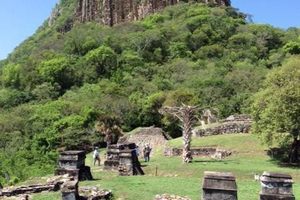
Driving north from the port city of Veracruz, a rock formation, known as Cerro de los Metates, rises dramatically above the level coastal plain of the Gulf lowlands. The monolithic mountain dominates the surrounding landscape. A steep ascent on a rutted dirt road leads to the base of the landmark’s vertical rock walls, and an ancient necropolis known as Quiahuiztlán. Here, during the Postclassic period (around 1100-1519), the Totonac inhabitants of the region erected 78 stone tombs, approximately four feet high, resembling miniature temples. Their contents originally contained human skeletal remains, polychrome pottery, and the metates (or grinding stones) that give Cerro de los Metates its name.
These houses of the dead are scattered throughout three areas of leveled, elevated ground, with some perched like sentries towards the Gulf of Mexico. The archaeological site offers spectacular views of the turquoise waters of Villa Rica, including the beach where Hernán Cortes landed in 1519. Villa Rica was the first European settlement in Mexico, and Quiahuiztlán is mentioned in various 16th-century Spanish chronicles recounting the Spanish-Aztec War.
While the tombs are the most unique feature here, two pyramids, a Mesoamerican ballcourt, defensive walls, plazas, stone steps, terraces, and other structural remains are scattered throughout the site. Paths lead through dense tropical foliage. Technical climbing routes entice climbers to scale one of several routes ascending the rock face. Chosen for its strategic position, the city was established around 800. By 1500, Quiahuiztlán was a thriving pre-Hispanic city of 16,000 inhabitants.
After exploring the site, consider lunch or a swim at nearby Villa Rica, one of the most beautiful and least discovered beaches in Mexico.