Pinckney's Tomb in Linden, Tennessee
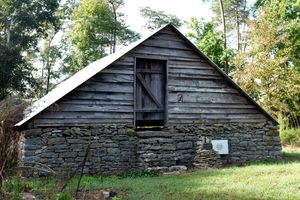
The Hufstedler Gravehouse (better known as Pinckney's Tomb) started out as a fairly unremarkable cut stone wall surrounding a small family graveyard. Built in the 1860s, it was able to hold about a dozen plots. But in 1885, a local farmer by the name of Pinckney Hufstedler decided to construct wooden walls and a roof over the cemetery, using the stone wall as a base, supposedly to prevent water from entering his grave after he died.
To add further mystery to the gravehouse's builder, he insisted that when he died, he be transported to his grave on a wagon drawn by white oxen. Pinckney died in 1895, and the last interment in the graveyard was his wife, Louisa, in 1924. It's unknown if his unusual final transportation request was honored.
For many years, the gravehouse was allowed to deteriorate and was in danger of falling into ruins. In 1987, it was added to the National Register of Historic Places. By the early 2000s part of one of the walls had collapsed, and tree roots had damaged another. Fortunately, county leaders and local preservationists were able to work together to conduct stabilization and repair work on this unique example of vernacular architecture, allowing future generations to ponder the fears, beliefs, and hopes of a long-dead eccentric farmer from this rural, often-forgotten corner of Tennessee