Lovelock Cave in Lovelock, Nevada
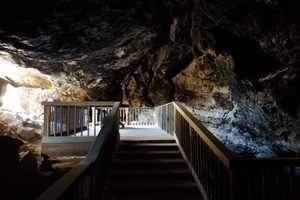
Bat guano (dung) was an improbable boom commodity around the turn of the last century. It was an important ingredient in fertilizer before artificial nitrogen fixation had been invented. Every "bat cave" became the center of a burst of mining activity, and Nevada's Lovelock Cave was no exception. In their excavations, the miners encountered Native American artifacts, which they largely discarded in a heap outside the cave. Only when the artifacts started to hinder the operation did professional archaeologists become involved in excavating the cave properly.
Unsurprisingly, the mining had seriously damaged the archeological record of the site, and as word got out that artifacts had been found looters added to the destruction. Later archeologists even referred to their work as a "salvage operation." Still, much information was recovered, and Lovelock Cave remains one of the best-documented archeological sites in the Great Basin in Nevada.
Some artifacts, missed by the looters, were later found, one of the most extraordinary being a cache of 11 woven tule decoys. They were finally dated in 1984 by carbon-14 accelerator mass spectrometry, which can be carried out with extremely small (milligram-sized) samples. The ages ranged from around 100-300 B.C., making these decoys among the oldest known.
Lovelock Cave overlooks the Humboldt Sink, where the landlocked Humboldt River ends. It is still a wetland—even now it will fill to form Humboldt Lake in wet years—and the area would have provided abundant resources for early Indigenous people.
The Paiutes, a Native American tribe in Nevada, passed down a story orally of a race of giant, red-haired "barbarians" called the Si-Te-Cah. The story goes the giant race was defeated at Lovelock Cave, and that perhaps some of the artifacts uncovered there were connected to the ancient people.