Ophir in Millett, Nevada
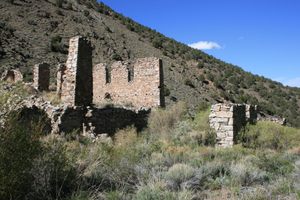
Silver was discovered in Ophir Canyon in the 1860s, but early mining efforts were defeated by the very hard rock which was unexpectedly expensive to drill and mill. After the discovery of a new orebody in the Murphy Mine, the only significant producer, a revival followed beginning in 1872 and lasting into the 1880s. However, activity had largely ceased by 1890 and the post office closed in 1893.
Ruins of the mill and a brick-and-stone building that was probably the store still can be seen, as well as several roofless stone cabins. The portal of the Murphy Mine itself remains open, although entering it is hazardous. Unfortunately, several years ago the Forest Service razed some of the remaining stone buildings as public hazards.
After the turn of the last century, there was only small-scale and intermittent activity on precious metal extraction. In the mid-20th century, however, tungsten deposits were discovered and worked near the canyon mouth. This lasted until the mid-1960s when the tungsten market collapsed due to the removal of the strategic-metal subsidies.
Little is left of the tungsten operations. A mill for tungsten to the south of the canyon mouth survived till the early 2010s but has since been torn down. A cemetery from the early days is preserved on the north side of the canyon mouth.