Warrington Transporter Bridge in Warrington, England
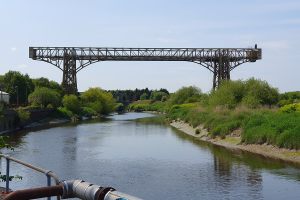
Transporter bridges are rather unusual bridges. They don't have an elevated road or walkway crossing over a river, chasm, or any other obstacle. Instead, transporter bridges use a moving platform suspended under a boom to transfer people, vehicles, or other things from one end of the bridge to the other. They are usually built in locations where a normal bridge may not be functional for various reasons. For example, a drawbridge may not be practical in some locations with ship traffic, or if not enough space is available on either side of a riverbank for approach ramps leading to a standard road bridge, a transporter bridge might be a more practical alternative.
Transporter bridges are also relatively rare. The United Kingdom currently has only three transporter bridges designed to carry vehicles, and the Warrington Transporter Bridge is one of them. The bridge was constructed in 1916 to connect two different parts of the chemical and soap plant operated by Joseph Crosfield & Sons. (This bridge was actually the second one built in Warrington over the River Mersey; the first bridge was built in 1905 but was later demolished in the 1960s.)
The steel bridge, which spans a section of the river that is 61 meters wide, has a height of 23 meters and a total length of 103 meters. The bridge was originally used to transport railway vehicles from one side of the river to the other but was later modified in the 1940s to transport road vehicles.
The bridge ceased to be used in 1964. It became a listed structure in 1975, which protected the bridge from demolition, but the bridge has been slowly decaying since. However, the people of Warrington are very proud of their bridge, and a group named the Friends of Warrington Transporter Bridge (FoWTB) formed in 2015 to raise awareness about the bridge as well as to work with Warrington Borough Council to try to restore the structure.
The Warrington Transporter Bridge may still be non-functional, but it has become one of the defining symbols of Warrington.