Sergeant Floyd Monument in Sioux City, Iowa
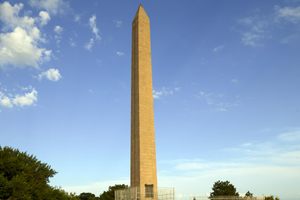
The Lewis and Clark Expedition was a resounding success given the goals set for it by President Thomas Jefferson. Over a two-year period, the Corps of Discovery explored the lands of the Louisiana Purchase all the way to the Pacific Ocean, making discoveries of exploitable natural resources and ushering in generations of settler colonialism and Manifest Destiny, all with but a single casualty. The body of the expedition’s only death, Sgt. Charles Floyd, is now entombed under an obelisk on a bluff overlooking Sioux City, Iowa.
Sgt. Floyd, the expedition’s quartermaster, took ill with what was likely appendicitis in July 1804 during the first leg of the journey. He wrote in his diary that he had “recovered his helth again,” that month, but his helth soon took a downturn. On August 20, 1804, he passed away at just 21 years of age He was buried with military honors on a bluff just south of a river, which was then named for him. A modest cedar gravestone was then placed over the location of his presumed final resting place. Unfortunately, Sgt. Floyd’s journey was only just beginning.
By the 1850s, the town of Sioux City had grown around the banks of what is to this day known as the Floyd River. South of town, Missouri River erosion had affected the bluff, and a heavy 1857 rainstorm washed away his grave. Alarmed citizens gathered whatever remains they could, and reburied him back of the river. His grave was then lost to history a second time, when in 1894, the rediscovery of his diary led the residents of Sioux City to once again search for his gravesite. A year later, his grave was found in a field trampled by cattle. His remains were exhumed, and he was reburied under a marble slab.
After nearly a century of being treated like lost housekeys, Sioux City residents wanted to finally do something grand with this young explorer’s remains. Inspired by the new Washington Monument, the Floyd Monument Association decided to build a 100-foot-tall obelisk. After five years raising funds, the monument’s construction began in 1900, and on Memorial Day, 1901, the monument was completed. Sgt. Floyd was entombed inside the monument, finally laid to rest at last. In 1960, the Sgt. Floyd Monument was named the first-ever National Historic Landmark in the United States, and efforts to preserve this site continue to this day.