Cobblestone Footpath in Culross, Scotland
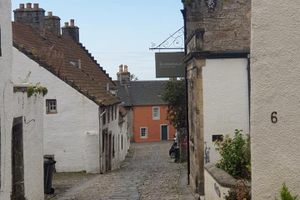
Many of the visitors that seek out the quaint seaside village of Culross, (pronounced Coo-riss) come to soak up the picturesque atmosphere seen on the television program Outlander. The town serves as the show's fictional village of Cranesmuir. But they might be missing some details that are easy to overlook. For instance, the pattern of the cobbled road of Kirk Street that runs from the Mercat Cross up to the Abbey.
Culross was founded in the 6th century, and due to the ingenuity of one of the town’s most prosperous citizens, it grew to a sizeable port that rivaled Glasgow by the 1600s. Sir George Bruce of Carnock (1568- 1625) established a coal mine, the first in the world that was located underwater. This, along with the production of salt from the Firth of Forth Estuary, would see the town explode in both population and prestige.
With the expansion of this tiny fishing village, a disparity arose between the mercantile and working classes. A prime example of this divide would be in the streets themselves. As there was no public sanitation system in place at the time, sewage, waste, and everything in between would be chucked out into the road, where it would eventually make its way downhill to the sea.
As one might imagine, the gentry were not about to soil their good threads and fine footwear. So, a path was created of larger stones that were slightly raised and ran down the middle of the walkway. This allowed members of high society to avoid a majority of the filth, while those less fortunate were left to wade through the muck in the gutters. It was a crime for the unworthy to use this elevated path, punishable by a fine or being tied to the pillory outside the Town House. This was a building located near the water’s edge, that acted as a courtroom, prison, and customs house.
Disaster struck Culross during a terrible storm in 1625, when the mine shafts were flooded. The village was not able to recover, it quickly lost its prestige and importance. Over the following centuries, it would fall further into a state of disrepair. Fortunately, The National Trust of Scotland purchased several buildings in the town and brought them back to their former glory. Now the town of Culross is known as the best-preserved 17th-century town in Scotland, and is sought out by film crews throughout the world.