Silver Falls State Park in Mehama, Oregon
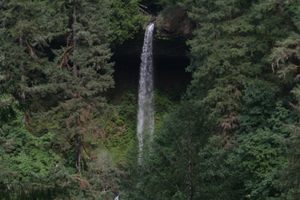
At around 8,700 acres, Silver Falls State Park is the largest state park in Oregon. It contains some 15 waterfalls centered around an attractive forested canyon with a large network of hiking trails. The falls flow over hard basalt ledges that are now often overhanging, as the underlying softer sandstone has been eroded away behind the falls.
In several cases, the hiking trail actually runs behind the falls. The basalt flows are part of the Columbia River Basalt sequence, which resulted from enormous eruptions in eastern Washington and Oregon about 15 million years ago. Some of the eruptions were so large they spilled down the Columbia River Gorge to the Pacific, and backed up into the Willamette Valley.
The area was recognized for its scenic value in the early 20th century, which was outstanding even with the extensive logging that had occurred around then. At the height of the Great Depression, in 1935, President Roosevelt designated the site as a Recreational Demonstration Area, and extensive recreational infrastructure was built by the Civilian Conservation Corps (CCC). Many buildings from that era have now been designated as National Historic Sites, and the CCC's legacy also lives on in the extensive set of hiking trails, many of which date from the 1930s. In addition, nearly a century after logging ceased the forest has largely regrown.