Moapa Airmail Arrow in Moapa Valley, Nevada
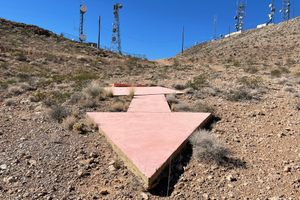
In the early days of flight, pilots had to follow landmarks on the ground, as radio was primitive and radar non-existent. And flying at night, as might be expected, was extremely hazardous and avoided if at all possible.
The rise of airmail service in the 1920s motivated improvements in the official airmail routes by building easy-to-recognize landmarks that would also allow night flying. Officially named Beacon Stations, these were large concrete arrows, originally painted yellow, that always pointed easterly on east-west routes and northerly on north-south routes. The arrows were also accompanied by a tower with a bright light so pilots could follow a course from light to light after dark.
This arrow is beacon station 31 LA-SL (Los Angeles to Salt Lake City) on CAM (Contract Air Mail) route 04. (It's also called Mormon Mesa #31.) The tower was salvaged for scrap decades ago, as were those at most of the beacon stations, but the arrow remains in remarkably good shape.