Tyrolean Tubtwist in Great Yarmouth, England
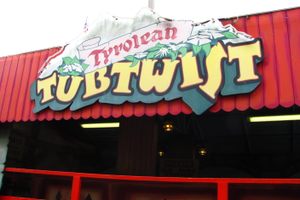
At Joyland Childrens Amusement Park in Great Yarmouth, England, visitors can ride the last of a vintage roller coaster style commonly known as a Virginia Reel.
The predecessor to modern spinning roller coasters, Virginia Reel riders sat facing inward within a tub-like vehicle. After being towed uphill, the tubs freely rolled down a side-friction track, wildly spinning as they navigated twists and turns. Henry Elmer Riehl, superintendent of Coney Island’s Luna Park, built the first in 1908. He named the ride after his daughter, Luna Virginia Riehl. The gleeful, head-spinning chaos was a hit with visitors, and dozens more Virginia Reels were built around the world.
Joyland’s version started operating in 1949, when the seaside amusement park first opened. Built by entrepreneur Horace Cole, the park’s small footprint did not allow for a full-sized gravity-driven Virginia Reel. So Cole engineered a smaller, electrically-powered variant of the Virginia Reel.
Riders of the Tyrolean Tubtwist still sit in spinning tubs that roll and spin along a winding trough-like track. Rather than rely on a lift and gravity-driven course, the vehicles are propelled by an electric motor along the tight, winding course. But there are still several downhill sections where the tubs freewheel under gravity, thus meeting the definition of a roller coaster.
One by one, the rest of the Virginia Reels came down, replaced by new steel coasters, and perhaps due to their wild and unpredictable experience clashing with modern safety regulations. The last gravity-driven version at England’s Blackpool Pleasure Beach was dismantled in 1982. Today, Joyland’s motorized and relatively controlled Tyroleon Tubtwist represents the final surviving variant of the original Virginia Reels anywhere in the world.