Salt Cave in Fallon, Nevada
Pleistocene Lake Lahontan covered much of western Nevada, with a peak level around 15,000 years ago. As the lake level dropped over the ensuing millennia, wave action along the shore caused substantial erosion, as the lake was still large enough to generate surf.
In some cases, the wave action carved out overhangs along the shore, as the surf dug into the material at the shoreline. In addition, due to the chemistry of Lake Lahontan, tufa, a freshwater limestone, was deposited abundantly around the lake, and tufa deposits encrusted the shoreline and were undercut and worn away by the surf.
Early Indigenous inhabitants occupied these wave-cut shelters several thousand years ago when the lake still provided resources before it vanished. Salt Cave is one such shelter, consisting of an arch-like tufa-encrusted alcove. The Hidden Cave at Grimes Point, directly east across the basin from Salt Cave, is another example.
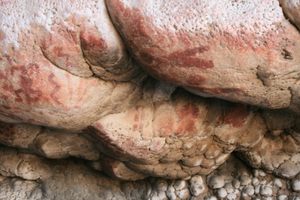
The tufa on the roof of Salt Cave is deeply soot-stained toward the back, both from the fires of early inhabitants and from those of later campers. Toward the entrance of the cave, where the tufa is whitish and largely free of soot, is an abundance of red ocher pictographs. Some are simply spots, while others are obvious hand prints, aligned dots, rosette-like features, wavy lines that may represent snakes or water, and even more enigmatic designs.
The white tufa may have been preferred as a substrate simply because the pictographs show up better, although some farther back may have later been covered by soot. Those nearest the entrance are faded and fragmentary due to weathering. The meaning of the pictographs is uncertain.