Holy Church of Saint Symeon of the Anapheans in Athens, Greece
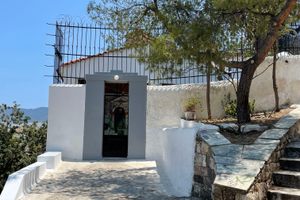
In 1840, experienced builders from the island of Anafi traveled to Athens to work construction jobs on the new Royal Palace and excavation sites around the Acropolis. Taking advantage of a new law, these builders hastily built houses on the steep northern hillside of the Acropolis and permanently relocated. They called their settlement Anafiotika, (“Little Anafi”), after their island.
In 1847, the residents identified a location on the northwestern side of their settlement to build a church. The location was originally the site of a 17th-century basilica, renovated in 1774, and severely damaged during the War of Independence. The residents rebuilt the church as a single-aisled basilica, with blind arches on the long walls and other transverse reinforcements.
The roof was terra cotta, with the bell tower being painted with terra cotta stripes in a German style. A large terrace was built on the western side, with two small Anafi-style outbuildings in the courtyard. The church had a frescoed interior, with numerous detailed icons, including one of the Virgin Mary Kalamiotissa that can still be seen in the church today.
The church was dedicated to St, Symeon the New Theologian, a Byzantine Christian monk and poet who was the last of three saints canonized by the Eastern Orthodox church. St. Symeon the New Theologian was born into a wealthy family in Anatolia in 949. He was educated as a youth in Constantinople, and at age 14 he met the renowned Elder Saint Symeon the Studite at the Studion Monastery.
St. Symeon the Studite became an early influence on the young Symeon and assisted him in preparing himself for monastic life. St. Symeon the new Theologian entered monastic life at age 27. He soon became the Abbot of the Monastery of Saint Mamas, a position he held for 25 years.
Upon the completion of the church, a priest relocated from Anafi and the church started serving parishioners and continues to do so to this day. The church still has strong ties to Anafi, having membership in the Association of Anafaia Everywhere.