Church of St. Dominic in Lisbon, Portugal
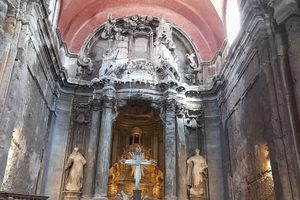
Still standing in the heart of the city’s downtown, near Rossio Square and Figueira Square, Lisbon’s Church of St. Dominic has survived two earthquakes–one in 1531 and a more devastating quake in 1755–and a fire in the 20th century.
Its foundations date back to the 13th century. Today, the church retains a few of its Romanesque origins, such as its Latin cross plan, round arches, and cradle-vaulted height.
For many years, the church was the Portuguese royalty's preferred location for weddings and christenings, but the building also honors its darker past. The church served as the launch pad of the 1506 massacre of Jewish peoples and New Christians. A round sculpture embedded with a Star of David sits near the church's entrance, memorializing the ignominious event.
The interior altar was updated in 1748, and the rest of the edifice was redesigned in the Baroque style after the 1755 natural disaster’s tremors and subsequent tsunami caused extensive damage. It was the massive fire of 1959 that left behind the scorched look it still sports today. Since, its walls, pillars, and stone sculptures surrounding the altar, resemble crumbling, melting candles.
The structural elements that survived the fire were left as-is, partially because of budgetary concerns but also a wish to remind visitors of life’s evanescence. Beyond a memento mori, the remains also testify to the resilience of Lisbon and its people.
With a contemporary, coral-painted ceiling and a few modern decorative and technological touches, the Church of St. Dominic continues to attract local parishioners, expats, and tourists through its daily masses and historical architecture.