Xerri’s Grotto in Xagħra, Malta
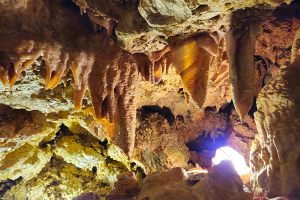
Layers of limestone are found underground throughout the Maltese Islands, and limestone is typically associated with the formation of underground caves with stalactites and stalagmites. This mineral contains calcium carbonate that may dissolve in water, so groundwater seeping through limestone can potentially remove a layer of the mineral to create a cavern. Once such a cave forms and when more groundwater drips through it, additional calcium carbonate in the water may be deposited within the cave to form stalactites and stalagmites.
In 1924, Anthony Xerri was digging a well behind his home when he broke into a small set of chambers with multiple stalactites and stalagmites but also filled with other rock debris. Xerri and his sons worked to clear the rubble and build a spiral staircase into the cave that made it into a small tourist attraction.
Aside from World War II, when the caves were used as a bomb shelter, Xerri’s Grotto has functioned as a tourist attraction ever since. Xerri’s descendants still own the cave and still conduct tours of the cave. The tour, which is led by one of the family members, starts with a brief discussion of the history of the cave in a small exhibition room on ground level before descending down a spiral staircase to the cave itself. Within the cave, special emphasis is placed on pointing out various rock features and their resemblances to various animals. Visitors are also encouraged to photograph the spiral staircase. These tours are also a nice respite from the hot Mediterranean summers for anyone passing through the Xagħra area.
Ninu’s Cave, a similar cavern that was discovered decades earlier, is located nearby.