Subic Spanish Gate in Subic Bay Freeport Zone, Philippines
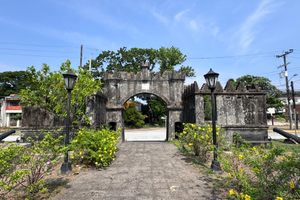
Tucked at the end of Dewey Avenue, you'll find a dark, stone fort that looks out of place among the modern surrounding areas with the tree-lined streets, proper sidewalks, and manicured front yards.
The Spanish Navy authorized the construction of the Arsenal de Olongapo on March 8, 1885, but the actual work started in September of that year. First, a harbor and a canal were built to make an island and separate the arsenal from the mainland. The newly built canal served as an additional line of defense over which a bridge was constructed. To enter the arsenal, two impressive gates were built to the west and south.
The main entrance to the arsenal was the west gate, which still stands today. This gate was equipped with gun ports and also served as a jail. Artilleries were stationed beside both gates. Thousands of tons of earth and rock from Kalalake in Olongapo had to be brought in as fill. The magnitude of this quarrying was so huge that a hill eventually disappeared and became a lagoon in the area now known as Bicentennial Park.
During the Philippine-American War, Filipinos occupied the arsenal, whereas the Americans used the Sangley Naval base in Cavite. It came to a fore on September 23, 1899 when the arsenal was attacked and destroyed by the Americans. They would go on to build the Subic Naval Base, the largest U.S. defense facility until 1992. The only standing remnant of the original arsenal is this massive Spanish gate.
On November 26, 2013, the Spanish Gate was declared a historical landmark by the National Historical Commission of the Philippines.