Homer Verne (Adams) Mine in Denio Junction, Nevada
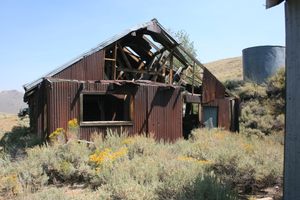
Brothers Homer and Verne Adams worked this mine beginning in about 1933. Production records are scanty, but the sheer scale of the operation indicates it enjoyed some degree of success. Operation presumably ceased in 1942 when gold mining was deemed inessential to the war effort.
The preserved buildings include some equipment directly related to the mining, such as an ore hopper and miscellaneous machinery. One of the most remarkable machines is an enormous hoist mechanism, powered by a large Ingersoll-Rand diesel engine, in the cavernous hoist house. There are also living quarters. Given the remoteness of the area, especially almost a century ago, the miners had to live on-site.
The orebody is described as a large gold-bearing quartz vein. This vein is roughly tabular in shape, such that it crops out in nearly a straight line up the hill behind the mine buildings. The excavations follow the mineralization, which accounts for their striking alignment as seen from a distance.
In the mid-1980s there was an attempt to reopen the mine, and some additional excavations were even carried out. However, the results must have been unpromising because no activity has occurred since.