Meadow Valley Wash in Etna, Nevada
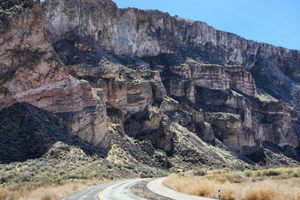
As early as the 1880s, not long after the completion of the Transcontinental Railroad at Promontory Point, there was serious discussion about a railroad connecting Salt Lake City with Los Angeles. Both cities had boomed in the late 19th century, and connecting them seemed good for business.
By the turn of the new century, two rival groups were building competing railroads, in the grand tradition of 19th-century railroad entrepreneurs: William A. Clark, the "Copper King," and Edward Henry Harriman of the Union Pacific. From 1900-02 the "Clark-Harriman" war ensued, carried out mostly in the courts but with a smattering of violence. Eventually, a joint-ownership compromise was reached, with the Union Pacific holding half-interest in Clark's San Pedro, Los Angeles, and Salt Lake railroad. (In 1916 it just became the Los Angeles and Salt Lake.)
With the ownership settled, the next question was the route south into Nevada. Meadow Valley Wash rises in the mountains of extreme eastern Nevada, not far from the Utah line. Just south of Caliente, it runs through scenic Rainbow Canyon, and ultimately, some 80 miles south, it joins the Muddy River near the village of Glendale, on what's now Interstate 15.
Because of its southerly trend, it seemed an obvious route for a railroad, but it is subject to extreme flooding. It was nonetheless chosen, with misgivings, because the alternatives would involve crossing mountain passes and thus involve large altitude changes.
The misgivings would be proven justified. Just after the route was completed in 1905, a flood took out much of the newly constructed right-of-way. More floods followed in 1906, 1907, and the biggest in 1910. As recently as 2005, the right-of-way in Meadow Valley Wash was shut down because of major flooding.
Nonetheless, the route is still in use. It is all part of the Union Pacific now, and it continues south through Las Vegas, where it played a major role in the creation of the modern city. It also remains a major rail link into Southern California, and includes both the old Kelso Depot and Afton Canyon in the Mojave Desert.